

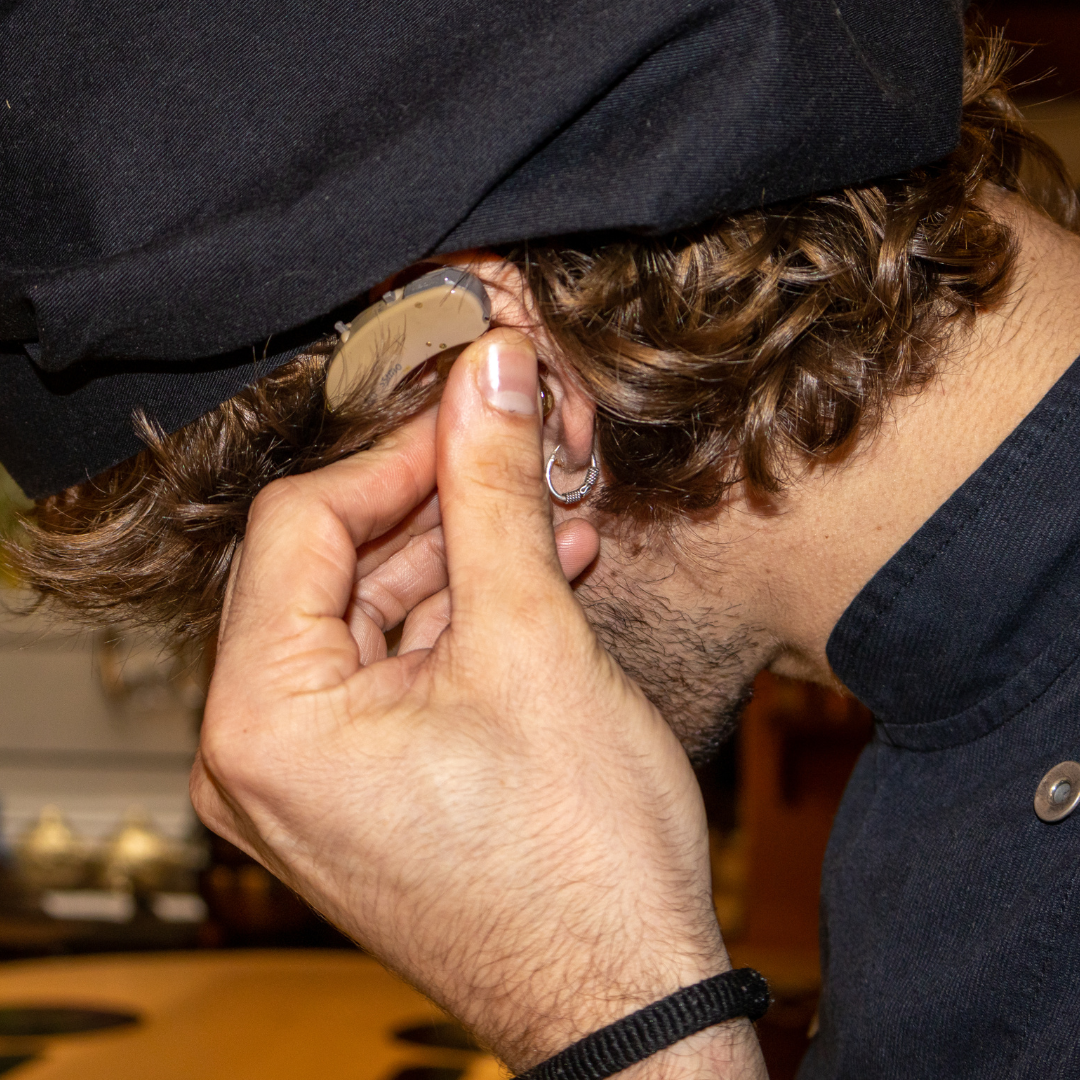
Restaurant conversations can be difficult to follow when environmental noise competes with your focus and hearing. We perform comprehensive diagnostic assessments to evaluate hearing in quiet rooms and challenging acoustic spaces to identify functional deficits. As soon as we identify the physiological cause of your difficult hearing, we deliver personalized rehabilitation options.
Why Can I Hear Normally but Struggle to Listen in a Restaurant?
Calm domestic settings establish a positive signal-to-noise ratio, allowing target speech to stand out clearly from faint background noises. Commercial restaurant spaces present the polar opposite acoustic dynamic. Overlapping chatter, piped music, kitchen clatter, and hard-surface reverberation mask speech, forcing the brain to expend immense cognitive effort to track conversation.
This problem can occur with high-frequency hearing loss, auditory-processing difficulty, or age- and noise-related changes. Cognitive exhaustion, physical fatigue, low ambient lighting, and increased distance from your conversational partner further compound the challenge. It is common to display normal baseline audibility on conventional hearing tests while failing comprehensive speech-in-noise testing. Difficulty in restaurants deserves evaluation even when everyday hearing seems normal.
Diagnostic Protocols for High-Frequency Hearing Loss
The diagnostic workup opens with an extensive intake examining difficult listening environments, past noise trauma, tinnitus presence, family history, and medical history.
Through pure-tone audiometry, we determine your faintest auditory perception across low to high pitches utilizing both air and bone conduction testing. High-frequency loss often creates an audiogram pattern in which thresholds become poorer as pitches rise. Additional testing may include tympanometry to assess middle-ear function and word-recognition testing to measure speech understanding.
Because testing in a silent booth does not mirror real-life restaurant environments, speech-in-noise testing supplies vital diagnostic clarity. This procedure gauges speech-discrimination accuracy while competing multi-source noise becomes incrementally louder. Interpreted together, these clinical scores demonstrate whether listening struggles originate from loss of audibility, speech clarity deficits, auditory processing delays, or combined elements.
Adult Auditory Processing Disorders and Speech Perception
An auditory processing disorder compromises how the central auditory pathways and brain decode incoming acoustic information. The physical ear mechanisms may capture tones correctly, but the central brain pathways struggle to filter competing inputs, parse similar consonants, or interpret rapid speech. We first evaluate peripheral hearing and then determine whether an individualized auditory-processing test battery or referrals to other professionals are appropriate.
Behavioral Strategies for Hearing Clearly in Loud Venues
Minor environmental adjustments can boost speech acoustic signals and supply critical visual lip-reading cues. Before dining out, choose a quieter restaurant or visit during an off-peak time. Venues with booths, acoustic panels, curtains, carpeting, and other sound-absorbing features may be easier than open rooms filled with hard surfaces.
Practical seating strategies in the dining room:
- Ask host staff for a quiet table distanced from kitchen traffic, bar noise, audio speakers, and loud group tables.
- Situate yourself with a structural wall behind you to minimize distracting ambient noise from behind.
- Position yourself to directly face companions under bright lighting to enhance facial comprehension.
- Keep conversational proximity as close as comfortably feasible to preserve acoustic signal strength.
- Position your better-hearing ear directly toward your main conversational partner.
- Instruct conversational partners to reword missed phrases instead of repeating the entire sentence verbatim.
- Confirm important details rather than pretending to understand.
- Step into a quiet area for a few minutes when listening fatigue begins to compromise focus.
- Encourage friends to enunciate clearly while maintaining an even, normal conversational tempo.
- Shouting can distort speech and does not necessarily make words easier to understand.
Advanced Technology for Hearing in Background Noise
Determining the proper hearing technology hinges on the underlying disorder, everyday listening environments, and whether peripheral hearing loss is diagnosed. Professionally programmed hearing aids incorporate multi-channel directional microphones, digital noise reduction algorithms, and custom restaurant settings to capture frontal speech while attenuating background interference. Patients must uphold realistic expectations because modern amplification cannot strip out every ambient human voice completely.
A remote microphone can provide a stronger improvement in the signal-to-noise ratio. The accessory is worn on the lapel or set near the speaker, streaming their voice directly into compatible hearing aids or wireless audio receivers. This reduces the effects of distance and surrounding noise.
Other useful options include:
- Omnidirectional table microphones designed for group dining tables
- Telecoil components connecting directly to public hearing-loop systems
- Real-time smartphone speech-to-text transcription and live-captioning apps
- Smart earbuds offering dedicated speech-in-noise amplification settings
- Decibel-monitoring apps and crowd-sourced dining platforms that track restaurant noise
We evaluate these technological options, ensure full hardware compatibility, and instruct you on maximizing your selected system.
How Medical and Audiology Specialists Resolve Hearing in Noise
A professional clinical assessment moves beyond basic baseline statements like “I hear fine in quiet rooms.” We assess the specific acoustic settings, speaker dynamics, and volume levels that disrupt your hearing to administer targeted evaluations. The diagnostic battery may encompass pure-tone thresholds, acoustic middle-ear evaluations, suprathreshold word recognition, and speech-in-noise measures. Auditory-processing testing may be considered when the history and initial results support it.
Sudden unilateral hearing drops, acute asymmetric changes, or rapid auditory decline mandate evaluation by an ear, nose, and throat physician. Dedicated individualized care pinpoints the underlying auditory cause rather than dismissing your struggles as standard restaurant noise.
Schedule a Diagnostic Hearing Evaluation Right Away
If restaurant conversations leave you guessing, withdrawing, or feeling exhausted, schedule a comprehensive hearing evaluation with us. Our clinical team will determine the best strategies to improve your hearing in noisy environments through custom hearing-aid programming, remote microphones, or targeted auditory rehabilitation.
Contact us to request an appointment and take the next step toward easier conversations.