

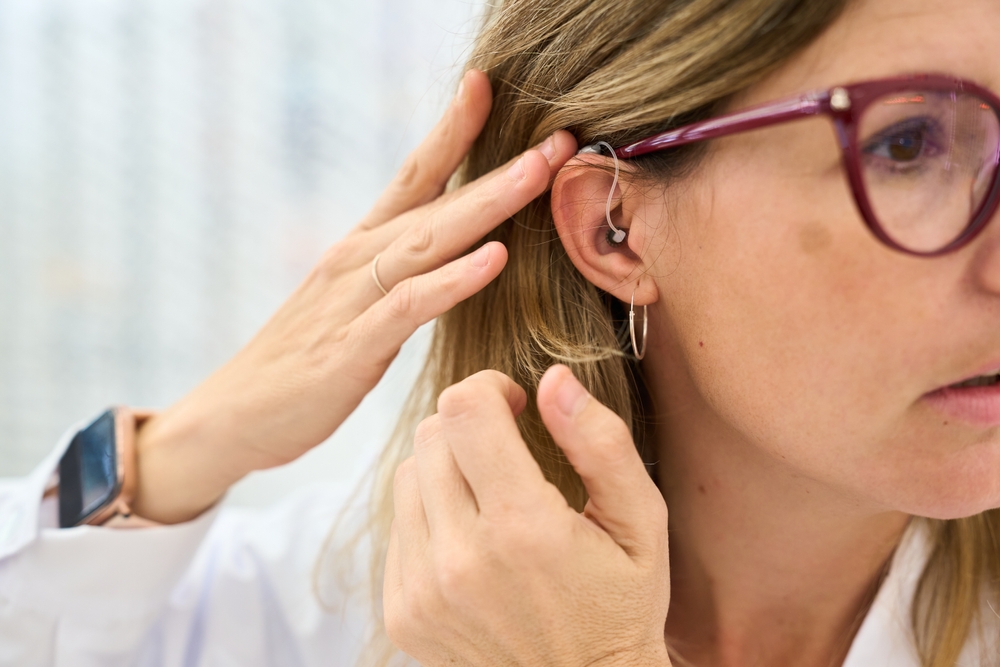
Many people delay getting hearing aids because they don’t think they’ll like how they look or feel. Such reluctance is perfectly natural when you consider past technology! In some cases, people even worried that they might be left out of conversation altogether by others who assumed they wouldn’t be able to hear or comprehend.
For many people, this image has stuck, making them hesitant to take the next step. In reality, the sophisticated hearing instruments of the present era deliver a look and feel that shatters these old assumptions. Ongoing innovations in cosmetic engineering mean today’s options are ultra-small, seamlessly comfortable, and beautifully hidden from public view.
If you’ve been putting off treatment because of how hearing aids used to look, it might be time to take a fresh look at what’s available today!
Why the Bulky, Obvious Hearing Aid Is a Thing of the Past
If you close your eyes and picture a hearing aid, you might imagine something large, hooked over the ear, and visible from across the room. Should that be your current expectation, you are inadvertently recalling the clunky designs common to the 1980s and 1990s.
Over the last few generations, this medical technology category has experienced a total structural evolution. Continuous refinements in ergonomic styling, nanometer-scale circuitry, and digital audio engineering have radically overhauled the modern cosmetic profile. They’re smaller, sleeker, and designed to blend in (or disappear entirely).
Numerous modern instruments are inserted completely within the ear canal structure, rendering them undetectable throughout standard daily dialogue. Different configurations sit comfortably behind the ear but feature such a low profile and featherweight build that observers naturally miss them.
Primary Hearing Aid Styles, From Invisible to Barely There
To understand how these sophisticated medical devices are physically configured, review this concise anatomical breakdown:
Invisible-in-canal (IIC)
These are as discreet as it gets. The IIC style fits exclusively within the deep internal canal and is built using a custom impression of the patient’s ear passagographic anatomy. During typical face-to-face communication, these custom models remain completely obscured from view. They remain an exceptionally sought-after solution for patients with mild-to-moderate deficits who refuse to compromise on cosmetic privacy.
Modern Standards: Receiver-in-Canal (RIC) / Receiver-in-the-Ear (RITE)
This architecture stands as the most frequently prescribed configuration in modern clinical practice. A micro-housing rests behind the upper pinna, transferring processed sound via an ultra-fine, translucent micro-wire to an acoustic driver nestled inside the canal. To a casual observer, their clean lines often mimic high-end commercial wireless earbuds. Most people won’t notice them unless they’re looking.
Streamlined Behind-the-Ear (BTE) Systems
These sit fully behind the ear and are slightly larger, but they’re still far more streamlined than older versions. They are typically prescribed to resolve advanced levels of hearing impairment, generating exceptional sound amplification without the cumbersome weight users traditionally dread.
The key takeaway: Today’s discreet hearing aids are designed to fit your life, not announce themselves.
The Functional Revolution: Modern Instruments Are Tiny Supercomputers
It is vital to recognize that this technological revolution is not simply a visual upgrade. Today, they function more like smart devices than traditional medical equipment. A vast majority feature native Bluetooth connectivity, enabling seamless, wireless streaming of telephonic communication, media, and television audio directly into your auditory pathway.
Most come with smartphone apps, so you can adjust volume or switch settings without ever touching the device. For instance, when entering a highly reverberant dining space, you can suppress ambient acoustic noise and sharpen speech clarity in mere moments. Furthermore, lithium-ion rechargeable cells have entirely eliminated the need to fiddle with microscopic, short-lived zinc-air batteries. Just place them on a charger overnight, like your phone.
Getting Over the Fear and Stigma of Hearing Devices
Even knowing all of this, it’s easy to hesitate. Initiating an auditory health journey can feel emotionally taxing because it requires acknowledging that our physical baseline has shifted over time. This mental hurdle can make an individual feel exposed, creating a false impression of losing authority over personal wellness.
Consider a healthier perspective: wearing a contemporary hearing system does not mean your body has failed you. They are merely an intelligent adaptation to a universal milestone of aging that impacts us all eventually. They’re proof that you’re taking action to support and equip your body in essential ways.
Imagine wearing a discreet, barely (if at all) visible device and finally being able to follow along in conversation, hear better in crowds, and focus on the things that really interest you. Talk about empowering!
Experience Contemporary Hearing Technology Firsthand
The easiest way to let go of that outdated mental image is to check out for yourself what’s available. We invite you to come in, ask questions, and explore your options with no pressure and no commitment necessary. Treat this as a risk-free exploratory step to comprehend the incredible aesthetic shift that has occurred in our field.
Almost every visitor walks out completely shocked by how weightless, ergonomic, and cosmetically invisible these tools are in practice! Reach out to our administrative team or visit our website right now to book your personal demonstration.